
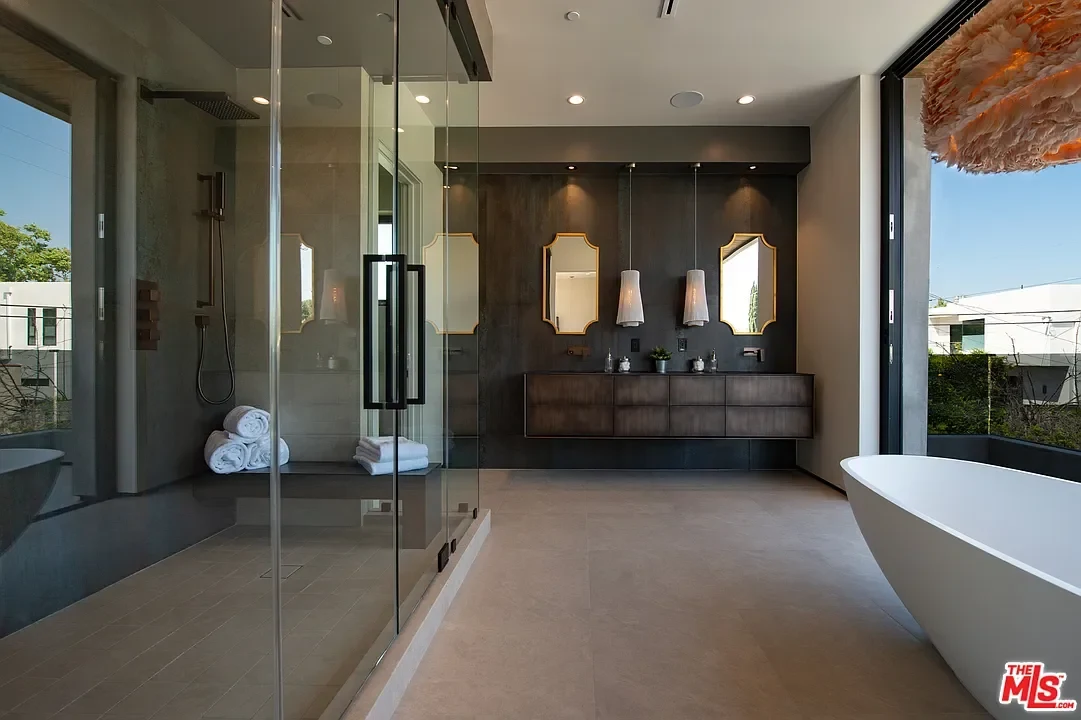
Start with atmosphere, then choose the stone
A stone bathroom does not need to feel like a showroom of slabs. We prefer to begin with the atmosphere: soft or dramatic, bright or cocooning, quiet or expressive. From there, one stone can establish the room’s visual language. A calm floor may support a more animated vanity top, while a strongly veined wall usually benefits from quieter surfaces around it.
In South Florida, daylight can be intense and reflective. View the actual stone samples vertically and horizontally in the room, because the same finish can read differently beside glass, water, and large windows. A honed surface often feels softer than a highly polished one, but appearance is only one part of the selection. The stone supplier and installer should confirm whether the specific material, finish, and format suit the intended wet-area application.
Treat waterproofing as part of the design
The most important surface in a shower is the one you never see. Stone and tile are finish materials; they are not, by themselves, the waterproofing system. Schluter’s current shower handbook makes that distinction clearly and shows how membranes, seams, penetrations, slopes, and drains must work as a coordinated assembly.
That coordination should happen before stone sizes, niches, benches, or linear drains are finalized. A beautiful slab layout can be compromised when plumbing locations and waterproofing transitions are resolved too late. Florida’s current building-code framework also governs wet-area construction, so the architect, contractor, and applicable trades should confirm the project-specific requirements and the manufacturer’s installation instructions rather than treating the finish plan as a substitute for technical detailing.
Let wood provide the counterpoint
Wood is especially useful when stone begins to feel visually cool. A tailored vanity, a recessed linen cabinet, or a framed mirror can introduce warmth without crowding the room. We favor restrained grain and a finish that relates to the adjoining bedroom or dressing area, so the bathroom feels connected to the rest of the home rather than designed as a separate theme.
The contrast works best when the materials do different jobs. Stone can carry the wet surfaces and architectural mass; wood can define the touch points and storage. In a humid room, the cabinet fabricator should select the construction, finish, hardware, and clearances for the actual conditions. Good ventilation and disciplined detailing matter more than simply calling a finish water resistant.
Design the maintenance routine before installation
Natural stone has character because it is not uniform, and its care should be understood before purchase. The Natural Stone Institute notes that calcareous stones are sensitive to acidic solutions and recommends mild, non-acidic cleaning products. It also explains that an impregnating sealer may improve stain resistance but does not make stone stain-proof.
For a homeowner, that means asking practical questions early: What cleaner is appropriate? Will soap residue be visible on this finish? How will the shower be squeegeed? Can the selected stone tolerate the household’s normal routine? A sample treated with the proposed sealer can be useful, but the stone supplier’s and sealer manufacturer’s written guidance should lead the decision.
The goal is calm, not perfection
A refined bathroom is usually the result of fewer, better-resolved moves. Align the stone joints with the architecture, give the vanity enough visual breathing room, and keep metal finishes subordinate to the larger material story. Before fabrication, review a coordinated elevation that shows slab seams, grout lines, niches, valves, outlets, mirrors, and lighting together.
Natural variation should remain visible; that is part of the appeal. When the technical layers are handled carefully and the palette is edited with restraint, stone brings permanence while wood brings ease. The room feels luxurious not because every surface demands attention, but because the details agree with one another.
Carmel Designs · South Florida
Tell us about your project ↗